Explore more [topic] on Gaia

Did The Druids Share a Common Ancestry With Other Ancient Civilizations?

Did The Druids Share a Common Ancestry With Other Ancient Civilizations?

There are few groups in history more enigmatic than those known as the druids. Today there are two neo-druidic sects, whose philosophy centers around a reverence for nature, diversity, and love. These are the often-cloaked people known to perform ceremonies in nature and at megalithic sites such as Stonehenge.

The Druids of antiquity are steeped in legend and folklore, having no written record of who they truly were or where they originally came from. The general consensus holds that they were a highly revered group, with a divine connection to nature and authoritative wisdom that trumped even the highest nobility. They are widely known to be of Celtic origin, but some alternative theories see them as having a common ancestry with ancient Eastern cultures or even one possibly originating in Atlantis.

Ancient Druids

In ancient times, Druids were known as wise elders who would congregate around oak trees. In fact, the word Druid or Druwid in Celtic translates to oak-knower or “knowing the oak tree,” though little is known what exactly this erudite group was really like. The recorded history of the ancient Druids typically falls into two categories; those that are based on ancient Roman writings, and those based on interpretations of writings seen as distorted Roman propaganda.

The Celtic Druids inhabited the area of Europe once known as Gaul, where they were eventually conquered by the Romans. One of the best-written accounts of the ancient Druids comes from Julius Caesar who described them as civilized, wise, and noble people, with the exception of their alleged ritual human sacrifice. Caesar and Tacitus led the conquering of Gaul and the subsequent persecution of the Druids, viewing them as overly superstitious and having dictatorial control over society.

The Druid religion was said to have sacrificed criminals in a massive wooden effigy, known as a wicker man, which was filled with people and set on fire. Caesar claimed that the Gauls were so consumed by the superstitions of Druidic rituals that they were quick to sacrifice, and would even offer up innocent people if they lacked sufficient criminals. Many contest this image of the Druids as inaccurate and an attempt by Caesar to depict them as a society worth integrating into Roman culture, albeit one that needed civilizing.
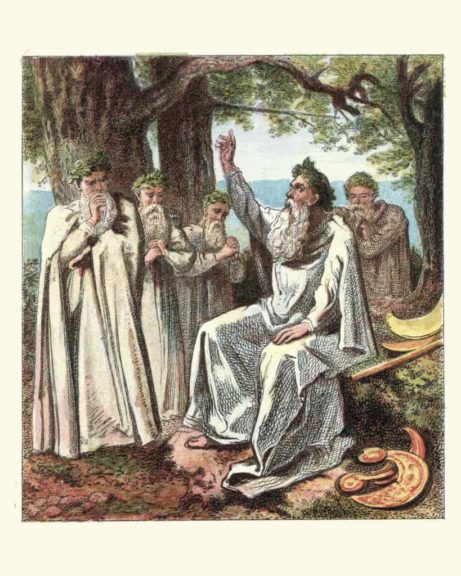
Ancient British Druids

Unlike most religious and spiritual beliefs in Europe at the time, Druids believed in reincarnation. They believed our souls were immortal and could be reborn into different lifeforms. Druid religion believed there were two planes of existence; the world we experience now, and the “otherworld.” Some think the Druids believed our souls would live and die in this world and then live and die in the otherworld, trading lifetimes in a cyclical process.

Numerous schools trained noble youth to become Druids. Depending on which type of role one was trained in, the Druidic educational system could take up to 20 years, significant schooling when life expectancy didn’t extend much past the age of 40. Still, it was considered highly esteemed to become a Druid, and despite the patriarchal nature of that era, women were made Druidesses with equal roles to men. The Druids worshipped female goddesses and a Druidess could take part in a battle or divorce her husband.

There were three roles that a Druid-in-training could aspire to prophet, priest, or bard. At school, all lessons were taught and memorized through lore. Song, poetry, and storytelling were of utmost importance, as Druids kept no written record, instead encoding their teaching into folk tales. This is part of the reason bards were so necessary for Druidism, as their songs served not just as historical records, but were also thought to have magical powers including the ability to induce sleep, change moods, and even cause illness or death.

Modern Druids

Today, the practice of modern Druidism is alive and well in two different branches of neo-Druidism. The Druid Order was the most well-known contemporary society of modern Druids until the early ‘60s when a new order, known as the Order of Bards, Ovates and Druids (OBOD) was established. This division has since gained notoriety across the world, claiming a 20,000-person membership.

OBOD runs online mentorships, classes, and workshops to develop its three disciplines, described as a spiritual practice that speaks to creativity, nature and wisdom. The three categorizations of OBOD are alternatively described as the Singer, Shaman, and Sage.

The Druid Order is known for the ceremonies conducted at Stonehenge throughout the year during Solstices and Equinoxes. They have conducted these for over a century and look to the cycle of the seasons as a regulator and key to unlock inner harmony.

They see modern Druidic beliefs not as a religion, but more as a fraternity or esoteric society that accepts all religions. They also pride themselves in observing and minding their own business. Only when asked for advice will a member of the Druid Order give his opinion.

Druid Symbol of Awen

Druid Symbol of Awen


One of the basics of the Druidic beliefs is the idea of Awen or the divine inspiration. It is otherwise described as gnosis, or the intuitive wisdom derived from the practice of Druidism. It is thought to be unique in every individual and is described as poetic inspiration. Awen is used to describe the poetry used by bards to pass down the story of the Druids, and modern usage describes poets and musicians in the same way. The symbol of Awen is depicted by three rays representing harmony and universal balance.

Alternative Theories  

Some theorize that the ancient Druids built Stonehenge, given their reverence for it, as well as other sacred monolithic sites. This idea was first posited by John Aubrey in 1640 and later perpetuated by William Stukeley. Though, theis theory has supposedly been discredited as radiocarbon dating showed the stones date back to 3,100 BC, while the known history of the Druids begins around 300 BC.

Still, there is no definitive proof or credible theory as to who built Stonehenge that has been widely accepted, leading some to believe that an ancient sect of Druids may have in fact, constructed the site. In more esoteric beliefs, an alleged group of ancient Druids from Atlantis are thought to have possibly constructed Stonehenge using some exotic, or anti-gravity technology.


Stonehenge in Britain

Stonehenge in Britain


Merlin, the legendary wizard in Arthurian lore, is sometimes credited as being responsible for moving the 10- 20-ton stones transported hundreds of miles to build Stonehenge. But some believe Merlin to have been a Pheryllt druid, named Taliesin, having practiced magical alchemy or who possessed anti-gravity technology.

Pheryllt was an esoteric sect of Druidism sometimes alluded to by bards. Its eponymous, esoteric text, the Lost Book of the Pheryllt, is thought to detail a common origin between many of the major ancient civilizations. The Pheryllt were said to have arrived in Wales after the sinking of Atlantis and share many similarities in their beliefs with Eastern dharmic religions.

The connections between Druidism and Hinduism are particularly striking. One similarity is found in the Druid’s sacred Awen, which looks and sounds much like the Hindu word Aum — both words representing the primordial sound of the universe. The Pheryllt also spoke of a female goddess, Cerridwen, who shares many parallels with the Hindu goddess Kali. Cerridwen’s divine feminine energy is often referred to much like Kali’s Kundalini energy.

Could there have been a common Atlantean origin or ancestry between the Celtic Druids and other ancient Eastern cultures? Similarities in mythology aside, there are also many parallels in their belief systems, including reincarnation and cosmology. Interestingly, the root words for Druid, dru and vid, when translated in Sanskrit mean, “immersed in knowledge.” It has also been common for many modern Druids to feel a connection with the dharmic teachings of these Eastern religions, leading members of OBOD to actively study this connection.


The Story of Atlantis, the Lost City

The history of Atlantis, with its sophisticated society and its tragic disappearance, has been the subject of study and fascination for centuries. In the series Initiation, Matias De Stefano offers a detailed and in-depth look at the evolution and impact of this lost city. In this article we explore the origins, structure, beliefs and fall of Atlantis, based on the accounts and knowledge shared by Matias.

Table of Contents

The Origins of Atlantis

The story of Atlantis begins with the arrival of the Anunnaki, giant beings from the Middle East, who settled on Earth to help their species survive while their own planet was dying. These extraterrestrial beings had children with humans, creating a new civilization that would eventually become the Atlanteans. This mixing of races allowed the Atlanteans to inherit advanced knowledge and skills from the Anunnaki.

The Greek god Poseidon, known to the Atlanteans as Talyn, was one of these Anunnaki. Talyn protected and guided twelve of these mixed-race children, leading them from their isolated civilization in the Middle East to the Atlantic Ocean, away from the dominating influence of other Anunnaki. This established the twelve families of Atlantis, each charged with preserving and transmitting the star information they possessed.

The twelve families of Atlantis divided the main island into twelve small regions, each controlled by a family. These were not traditional rulers, but guardians of cosmic information. Through their connection to the stars, the Atlanteans developed a civilization that valued both spiritual knowledge and technological advancement.

The purpose of Atlantis was to be an experiment in human evolution, run by star beings such as the Arcturians and Pleiadians. These beings taught the Atlanteans to use sacred geometry and cosmic energies to build structures that were not only architecturally impressive, but also spiritually potent. These practices enabled the Atlanteans to achieve high levels of consciousness and wisdom.

In the series Initiation, available on Gaia, Matias De Stefano explores these origins in depth, revealing how ancestral knowledge and connection with beings from other dimensions shaped the advanced civilization of Atlantis.

The Structure of Atlantis

The structure of Atlantis stood out for its advanced organization and the integration of spiritual and technological principles in its urban and social design. The following are the most relevant aspects of this civilization:

  • Regional distribution: Atlantis was divided into twelve regions, each governed by one of the twelve families. These regions represented not only administrative divisions, but also areas of spiritual and technological responsibility.
  • Spiritual rule: The twelve families that ruled Atlantis were not monarchs in the traditional sense, but guardians of cosmic wisdom. Their leadership was based on spiritual knowledge and ethical guidance rather than authoritarian control.
  • Circular city: The capital of Atlantis was a circular city located on the main island. This layout reflected the harmony and balance that the Atlanteans sought in all aspects of their lives.
  • Resonance technology: The Atlanteans used vibration and sound technology for building and healing. This technology allowed the construction of pyramids and temples that acted as resonance points for communication and energy transfer over great distances.
  • Sacred geometry: Atlantean architecture incorporated principles of sacred geometry, using shapes and patterns such as the Flower of Life to align their structures with cosmic energies, facilitating meditation and spiritual connection.
  • Portal network: Atlantis had a network of natural and artificial portals that allowed the connection with other dimensions and the transfer of cosmic information. This network was fundamental for its spiritual and technological evolution.
  • Wisdom centers: Temples in Atlantis served as places of knowledge and energy. They were designed to optimize energetic resonance, facilitating advanced spiritual practices and connection with cosmic forces.
  • Stellar influence: The knowledge and skills of the Atlanteans came from their interaction with beings from other worlds, such as the Arcturians and Pleiadians. This interaction profoundly shaped their culture, religion and technology, integrating cosmic knowledge into their daily lives.
  • Strategic expansion: During their heyday, the Atlanteans established settlements in key regions such as Egypt and the Mediterranean. These settlements not only expanded their territorial influence, but also allowed them access to important energy portals around the world.

Their Spiritual and Religious Beliefs

The spiritual beliefs of the Atlanteans were deeply rooted in an understanding of the connection between the cosmos and life on Earth. They believed that all divinities were different expressions of a single universal consciousness. This approach allowed the Atlanteans to see every aspect of nature and the cosmos as a divine manifestation. Natural elements such as water, fire, earth and air were considered sacred, and each had its own gods and guardian spirits. This worldview fostered a deep respect for nature and the interconnectedness of all life.

One of the pillars of Atlantean spiritual beliefs was the practice of sacred geometry. Atlanteans used specific shapes and patterns, such as the Flower of Life, to align their structures with cosmic energies. They believed that these geometric shapes were the key to understanding and manipulating the energies of the universe. Temples and other important buildings were built according to these principles, allowing the Atlanteans to create spaces that facilitated meditation and spiritual connection.

Atlantean rituals and ceremonies were designed to maintain balance and harmony at both the individual and collective levels. They used vibration and sound to heal and elevate their consciousness, integrating practices such as chanting and harmonic resonance. These ceremonies not only strengthened the community, but also served as a means to align with cosmic forces and receive spiritual guidance. This holistic approach to spirituality allowed Atlanteans to live in harmony with the universe and foster continued spiritual growth.

The Heyday of the Atlantean Empire

At its peak, Atlantis had a population of approximately 300,000 people distributed in several villages along three main islands. This distribution reflected the advanced organization and planning of the Atlantean civilization.

The Atlantean empire reached its greatest expansion by establishing settlements in the Mediterranean and beyond. Following Earth’s energetic patterns, the Atlanteans founded colonies in regions such as Egypt, Asia Minor and the Middle East. These settlements not only extended their territorial influence, but also allowed them access to important energetic portals that strengthened their connection to cosmic energies. Atlantean expansion was both a territorial conquest and an effort to unify the planetary energies under their control.

Atlantean technology played a crucial role in their heyday. They used vibration and sound to build and heal, developing a network of pyramids and temples that functioned as resonance points. This network allowed the Atlanteans to communicate and transfer energy over great distances. In addition, this technology was used for cell regeneration and life extension, demonstrating their mastery over natural forces and their ability to manipulate physical reality.

The Atlantean system of government was based on wisdom and spiritual guidance. The twelve families that ruled Atlantis were not tyrants, but guardians of cosmic wisdom. Their leadership was focused on maintaining balance and harmony in society, using their knowledge of the stars and sacred geometry to guide the civilization toward sustainable and spiritually advanced development. This approach allowed Atlantis to flourish as a prosperous and balanced civilization, capable of integrating advanced technology with deep spirituality.

The Fall of Atlantis

The fall of Atlantis is one of the most tragic and fascinating stories of antiquity. The Atlantean civilization began to disintegrate during the Age of Scorpio. This period was marked by an abuse of the knowledge and technology possessed by the Atlanteans. The leaders of Atlantis, once guardians of cosmic wisdom, began to use their abilities to exert power and control over others, deviating from their spiritual and ethical principles.

This abuse of power led to a series of natural catastrophes that contributed to the destruction of Atlantis. The Atlanteans had developed advanced technologies that used frequencies and resonances for multiple purposes. However, these same technologies were employed for war and domination, resulting in devastating energy waves that caused the disappearance of entire cities and turned fertile regions into barren deserts.

Internal tensions and conflicts with other civilizations also played a crucial role in the fall of Atlantis. The war with the civilization of Mu was especially destructive, leading to a series of battles that depleted Atlantean resources and morale. Finally, a combination of natural disasters and internal social collapse culminated in the complete destruction of the Atlantean civilization, with the main island sinking into the ocean in a single night of misfortune.

Khem: The New Atlantis

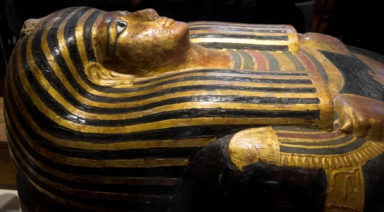
Khem, known as the new Atlantis, emerged after the collapse of the Atlantean civilization. This transition occurred during the Age of Virgo, when the remaining Atlanteans migrated and established new bases in Egypt and other regions of the Mediterranean. Khem inherited much of Atlantean knowledge and practices, including the use of sacred geometry and vibrational resonance in their constructions. The temples and pyramids of Egypt bear witness to this transfer of wisdom, which continued to influence the spiritual and technological development of the region.

The new civilization of Khem focused on maintaining and expanding Atlantean knowledge, adapting it to its new environment. This integration allowed Khem to flourish as a center of learning and spiritual evolution. Khem’s leaders, many of them descendants of the ancient Atlantean guardians, worked to preserve the harmony and balance that once characterized Atlantis. Thus, Khem became a bridge between the legacy of Atlantis and future civilizations, ensuring that the lessons learned would not be lost to time.

The Legacy of Atlantis

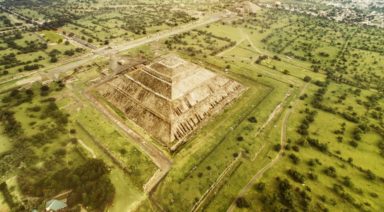
Despite its destruction, the legacy of Atlantis lives on in numerous cultures and traditions around the world. The teachings and technologies of the Atlanteans were carried to new lands by their survivors, influencing regions such as Egypt, Greece and Central America in their mythology, architecture and spiritual practices. These cultures reflect Atlantean knowledge of sacred geometry and cosmic alignment in their monuments and temples.

The spiritual impact of Atlantis is also evident in many religions and esoteric philosophies. The principles of connection to the cosmos, the importance of energetic alignment, and the use of vibration and sound for healing and evolution are concepts that have endured throughout the centuries. These teachings continue to inspire spiritual seekers and modern practitioners who seek to integrate these principles into their daily lives.

In addition, the story of Atlantis has been a catalyst for exploration and the search for lost civilizations. Archaeologists, historians and explorers have dedicated their lives to unearthing the remains of this ancient civilization, searching for evidence to corroborate the accounts of Plato and others. These efforts have led to numerous important discoveries that have enriched our understanding of ancient cultures and their connection to Atlantis.

The story of Atlantis continues to be a source of inspiration and reflection on human potential and our capabilities. It reminds us that while we can reach great heights of knowledge and technology, we must do so with a sense of responsibility and ethics. The legacy of Atlantis urges us to learn from its mistakes and use our abilities to create a more harmonious and balanced world, avoiding the paths that led to its downfall.

Read Article

Our unique blend of yoga, meditation, personal transformation, and alternative healing content is designed for those seeking to not just enhance their physical, spiritual, and intellectual capabilities, but to fuse them in the knowledge that the whole is always greater than the sum of its parts.


Use the same account and membership for TV, desktop, and all mobile devices. Plus you can download videos to your device to watch offline later.

devices en image
Monthly
$13 .99 /mo
BILLED MONTHLY
Select
First 7 days FREE
then $13.99 billed monthly, cancel anytime
Gaia+
$24 .92 /mo
BILLED ANNUALLY
$299 /yr
Select
Includes Events & Guides
$299 billed annually, cancel anytime
All prices USD plus applicable tax
Testing message will be here